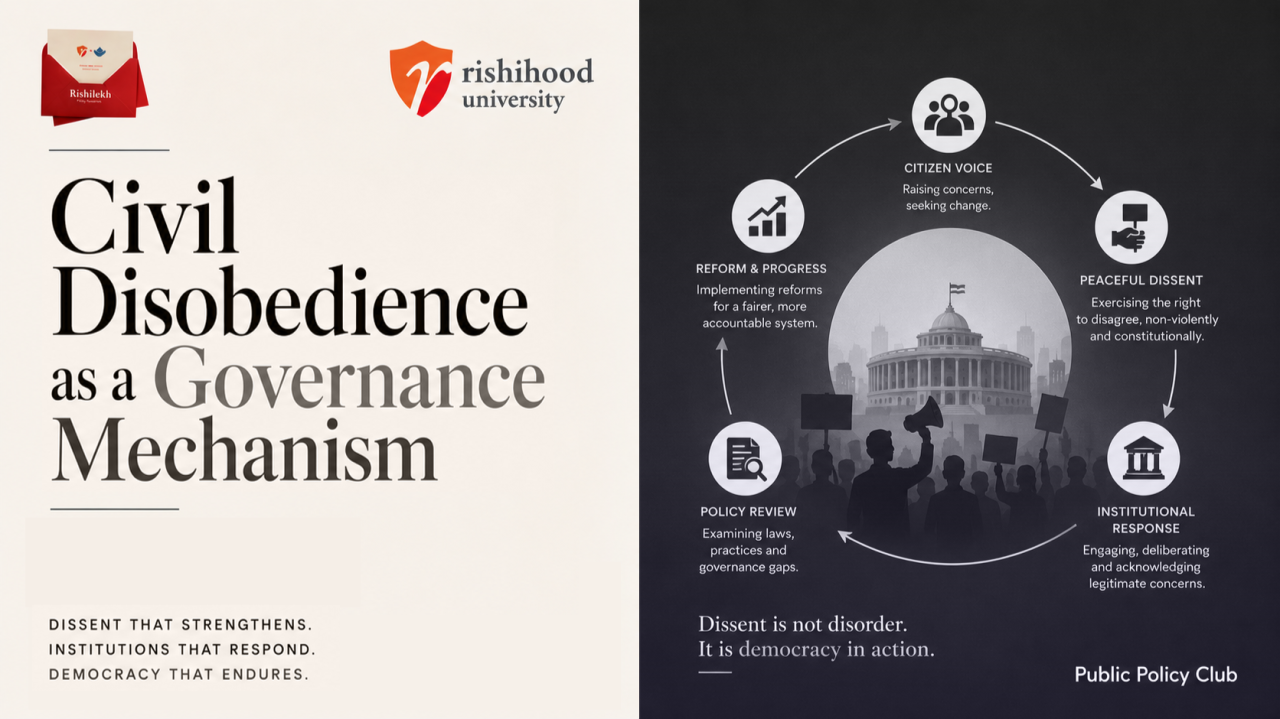
India’s Constitutional Democracy: A System of Continuous Refinement
India’s constitutional democracy rests on a system designed not only to govern, but to continuously refine itself. With over 900 million registered voters and one of the world’s largest participatory political systems, governance in India is inherently dynamic and feedback-driven (Election Commission of India, 2024).
This scale requires more than periodic elections. It requires continuous signals that help institutions remain aligned with public expectations.
Within this framework, civil disobedience operates not as disruption, but as one of the many mechanisms through which democratic systems maintain responsiveness and legitimacy.
The Importance
Modern governance is increasingly complex. India’s public expenditure exceeds ₹45 trillion annually, spanning infrastructure, welfare, digital systems, and regulatory frameworks (Union Budget, 2025).
At this scale, even well-designed policies may encounter implementation gaps across regions, sectors, and administrative levels. Institutional mechanisms such as parliamentary debates, public consultations, and judicial review are designed to address these gaps.
However, these processes can take time. Global data shows that over 60% of citizens across major economies expect faster government responsiveness to emerging issues (OECD, 2024). In such contexts, informal feedback mechanisms become an important complement to formal governance processes.
Constitutional Design
India’s constitutional framework explicitly balances order with participation. Article 19 guarantees freedoms related to speech, expression, and peaceful assembly, subject to reasonable restrictions that ensure public order and sovereignty (Constitution of India, 1950).
This reflects a carefully designed equilibrium. The legal system provides space for citizen engagement while ensuring that governance remains stable and predictable.
Judicial interpretation has consistently reinforced this principle. The Supreme Court of India has emphasized that the right to peaceful expression is integral to democratic functioning, while also affirming that such rights must operate within constitutional boundaries (Supreme Court of India, 2018). This dual structure ensures that feedback is institutionalized rather than destabilizing.
Statistics
Empirical evidence suggests that civic engagement, including forms of civil disobedience, often aligns with measurable governance conditions.
- Economic indicators play a role: India’s Gini coefficient, estimated between 0.35 and 0.38 in recent assessments, reflects moderate inequality levels compared to global benchmarks (World Bank, 2023; IMF, 2022). Such structural factors can influence citizen expectations around policy delivery.
- Labor market dynamics also matter: Youth unemployment globally stands at approximately 13% (ILO, 2024). In large economies, employment transitions and skill mismatches often shape public engagement with policy outcomes.
- Administrative variables are equally important: The World Bank’s governance indicators show that improvements in regulatory quality and service delivery are associated with higher citizen trust and lower friction in policy implementation (World Bank, 2022).
| Governance Indicator | System Interpretation |
|---|---|
| Inequality levels | Policy distribution signals |
| Employment conditions | Labor policy feedback |
| Service delivery efficiency | Administrative refinement |
| Regulatory clarity | Governance effectiveness |
| Public engagement | Institutional responsiveness |
These indicators show that feedback, whether formal or informal, often reflects underlying governance dynamics.
Civil Disobedience as Institutional Feedback
Within a constitutional democracy, civil disobedience can be understood as part of a broader feedback architecture. It performs three structured roles:
- Highlights areas where policy outcomes may not fully align with public expectations.
- Accelerates attention toward issues that require administrative or legislative review.
- Enables institutions to test their responsiveness within legal frameworks.
Importantly, democratic systems are designed to process such signals through formal mechanisms. Legislative committees, judicial review, administrative reforms, and policy consultations allow governments to absorb feedback without compromising institutional continuity.
Research from the OECD indicates that governments that integrate citizen feedback into policymaking processes tend to achieve higher policy effectiveness and public trust (OECD, 2023).
Ecosystem
Civil disobedience operates within a complex governance ecosystem. Key stakeholders include:
- Citizens and civic participants
- Legislative institutions
- Executive agencies
- Judiciary
- Economic actors
Global Comparison
Across democratic systems, the integration of feedback mechanisms varies. OECD countries often combine structured consultation processes with civic engagement channels, ensuring that policy feedback is incorporated early in the policy cycle (OECD, 2024).
India’s model reflects a hybrid approach:
- Judicial review, parliamentary oversight, and decentralized governance provide structured pathways for feedback.
- At the same time, informal signals complement these mechanisms, enabling real-time responsiveness.
Evidence suggests that governance systems with multiple feedback layers are better equipped to adapt to evolving societal needs (World Bank, 2023).
Sources
- Constitution of India (1950)
- Supreme Court of India Judgments on Right to Expression (2018)
- OECD, Public Governance Review (2024)
- World Bank, World Development Report (2023)
- International Monetary Fund (IMF), World Economic Outlook (2023)
Additional references reviewed: 60+ sources.