You've probably seen it while scrolling. A completely normal video, a friend's trip reel, a creator's talking head clip, sometimes even a post from a big personality, carrying Instagram's quiet little 'Al info' tag. Nothing about the video looks synthetic. No uncanny faces, no glitching hands, no robotic voice. It's just a real video, with a label that says otherwise.
If you've noticed this happening more often lately, you're not imagining it. And the reason behind it says less about how smart Instagram's Al detection is, and more about how it actually works, which turns out to be far blunter, and far more revealing, than most people assume.
It's Not Watching Your Video. It's Reading a Receipt.
Here's the part almost nobody realizes. When Instagram slaps an 'Al info' label on a video, in the overwhelming majority of cases, no system has actually watched the video and judged it to be synthetic. Instead, Instagram is reading an invisible tag buried inside the file itself, a bit of metadata, not unlike a receipt stapled to the inside of the video, listing which software touched it and how.
This tagging system is called 'C2PA' (Coalition for Content Provenance and Authenticity), backed by Adobe, Microsoft, Google, Meta, and OpenAI. Whenever you edit a video in a tool like Adobe Premiere, Photoshop, or CapCut, and that tool uses any Al-assisted feature (auto-captions, an Al color grade, a background removal, even a smart crop), the software often writes a small, cryptographically signed note into the exported file saying, in effect, "AI was involved here." Instagram's upload servers scan for that note the moment your file lands on their servers, before your video is even fully processed. If the note is there, the label gets applied, and cached in Instagram's system, almost instantly.
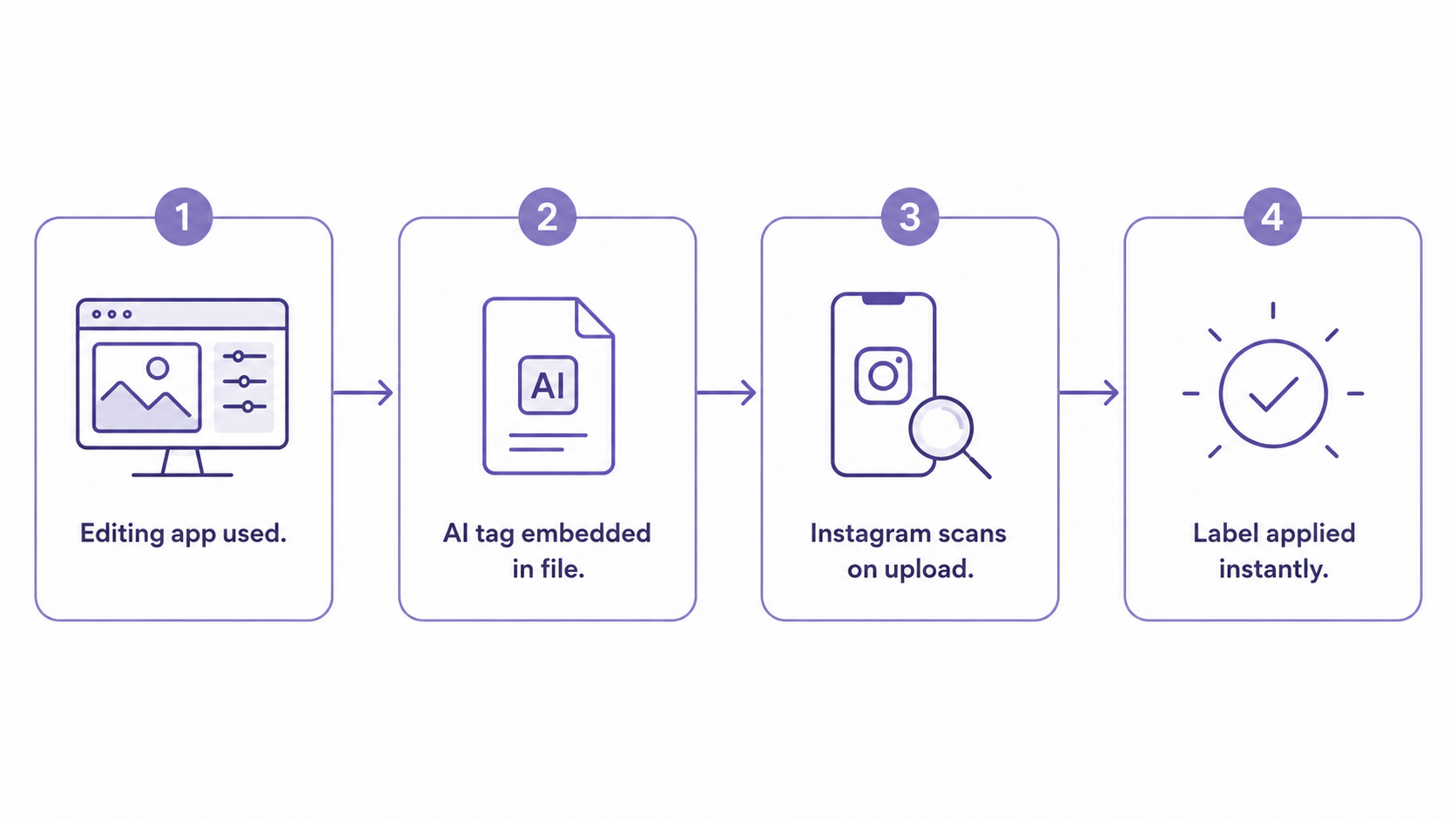
The problem is obvious once you see it. That note doesn't distinguish between "this entire video was generated by Al from a text prompt" and "someone used one Al-powered noise-reduction tool to clean up wind sound on an otherwise fully real video." Both get the exact same label. As one photographer put it after his real, unedited photo got flagged over a routine Photoshop crop, if this counts as 'made with AI,' the term stops meaning anything at all.
One AI Tool, and the Whole Video Gets Tagged
Video is especially vulnerable to this, more than photos ever were. A photo is usually one file, lightly touched. A video, on the other hand, is assembled: multiple clips, an audio track, transitions, captions, rendered into one final export. If even a single element in that timeline used an Al-assisted tool (say, CapCut's auto-caption feature, or Premiere's Al-powered audio cleanup), the exported file inherits an Al tag for the entire video, not just that one element. Creators have reported CapCut exports with Al captions enabled getting flagged as fully 'AI-generated' the moment they're uploaded, even when every frame of footage was shot on a real camera, by a real person.
This is why you're seeing it more with big personalities specifically. Professional creators use professional editing pipelines, and professional editing pipelines lean on Al-assisted tools constantly, for entirely mundane reasons: clean audio, smart captions, quick color correction.
The Twist: This Same System Often Lets the Real Fakes Through
Here's where it gets genuinely strange, and this is the detail that makes the whole story worth telling. That metadata receipt is fragile. It's cryptographically bound to the exact byte sequence of the video file, which means the moment a video is re-encoded, compressed, or run through a converter, the receipt breaks and effectively vanishes.
That cuts two very different ways.
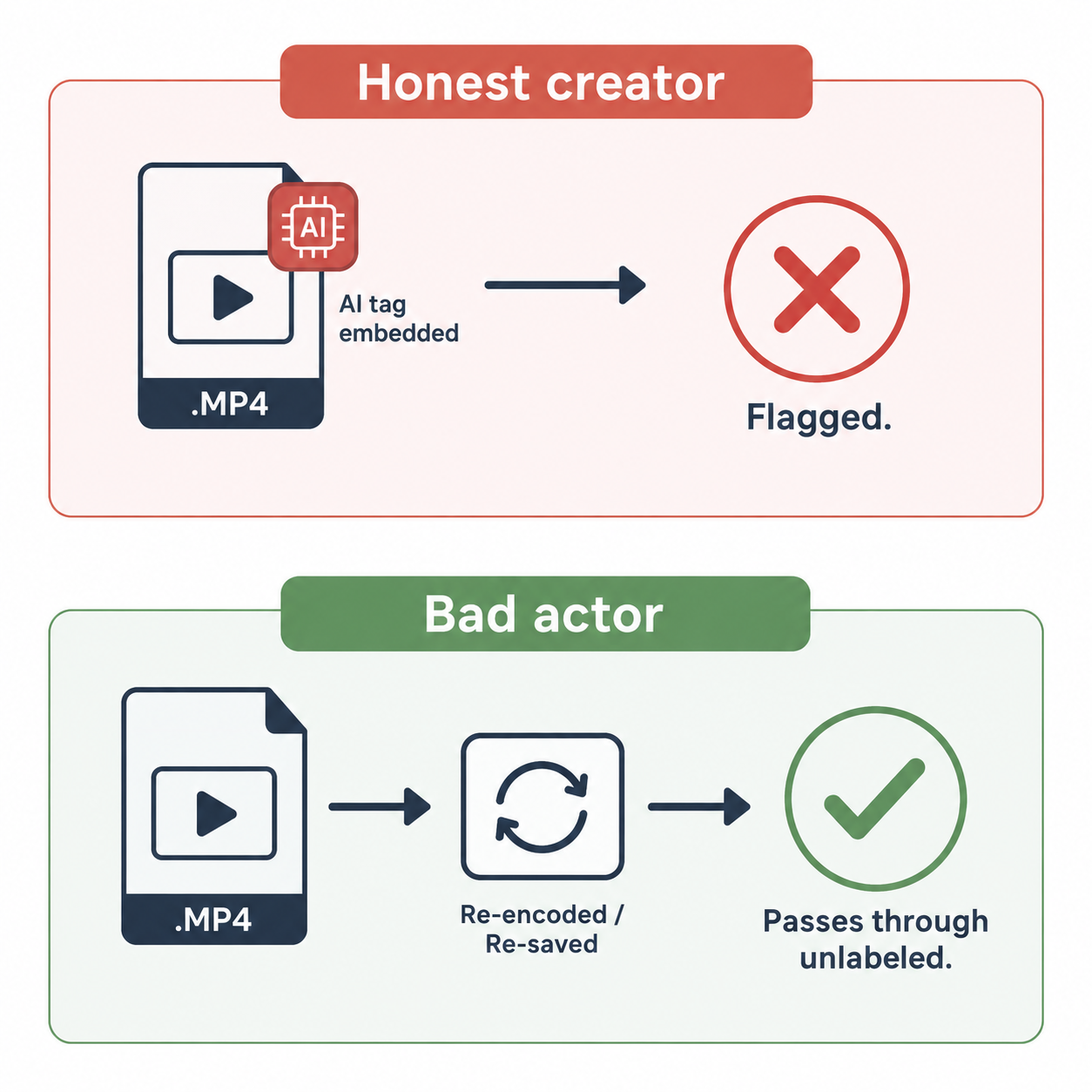
An honest creator uploads a real video edited with one Al tool. Instagram reads the metadata the instant it's uploaded, before any of its own compression happens, so it catches the tag and locks in the 'AI info' label right away.
A bad actor, meanwhile, deliberately runs an actual Al-generated deepfake through a basic re-encoding step before uploading, something a whole cottage industry of 'metadata stripping' tools now exists to do in a couple of clicks. That single step destroys the C2PA receipt entirely. Instagram's scanner finds nothing, and the fully synthetic video uploads with no label at all.
So the system, as it currently works, is often more reliable at flagging a genuine creator's lightly edited real video than it is at catching an actual deepfake built to deceive someone. That's not a minor bug. It's close to the opposite of what the label is supposed to do.
Why a Wrong Label Still Does Real Damage
It would be easy to shrug this off as a cosmetic glitch, except research suggests the label changes how people actually respond to content. A 2024 study published in PNAS Nexus (Altay and Gilardi, University of Zurich), surveying nearly 5,000 participants across two experiments, found that tagging content as "AI-generated" measurably lowers how accurate people think it is and how willing they are to share it, even when the content is true, and even when it was actually made by a human.
In other words, the label doesn't just sit there quietly. Viewers see 'AI info' and mentally jump straight to "this is fake" or "this is fully automated," not "someone used a caption tool." For a creator, journalist, or organisation whose credibility depends on being seen as authentic, that's a real, if invisible, cost, inflicted by a system that, by its own design, can't actually tell the difference between a deepfake and a denoised interview clip.
So Why Would Platforms Build a System This Blunt?
This is the part that makes it a public policy story, not just a tech support story.
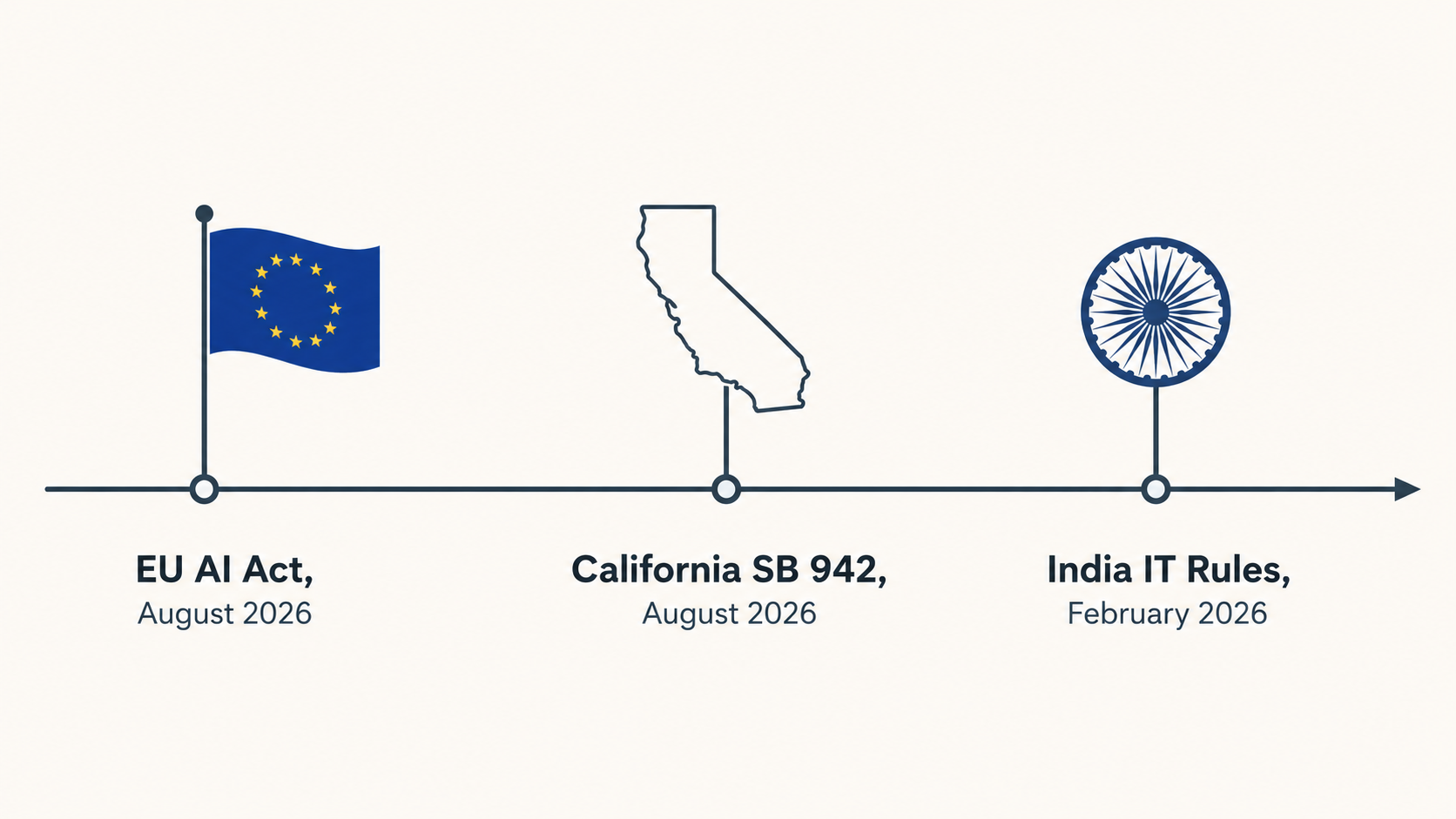
Since August 2, 2026, the European Union's AI Act, specifically Article 50, has legally required platforms to clearly disclose realistic Al-generated or manipulated content depicting real people, places, or events. The penalties aren't symbolic: breaches of Article 50 can draw fines of up to €15 million or 3% of a company's global annual turnover, whichever is higher. For a company the size of Meta, that's a potential billion-euro exposure.
California moved to land on the exact same date. Its AI Transparency Act (SB 942) requires large Al systems to embed detectable provenance signals and offer public detection tools, backed by civil penalties of $5,000 per violation, per day. The law was originally set to take effect January 1, 2026, but a follow-up bill (AB 853) pushed the date to August 2, 2026, explicitly to line up with the EU's own deadline. Two of the world's largest regulatory blocs chose, independently, to demand the same thing on the same day: a machine-checkable answer to "did Al make this?"
It's worth noting that not every US attempt to regulate synthetic media has survived. California also passed two separate laws aimed specifically at election-related deepfakes (AB 2655 and AB 2839), and a federal judge blocked both on First Amendment grounds, ruling that they were too broad and swept up protected satire and parody along with genuine deception. That's a useful contrast: the "you must disclose Al involvement" model (EU Article 50, California SB 942, India's rules below) has held up in court so far, while the "you must remove or ban certain deepfakes outright" model has run straight into free speech protections in the US. Disclosure mandates and takedown mandates are legally very different animals.
Faced with fines that scale into the billions for missing a real deepfake, versus irritating a creator whose Reel got an unwarranted tag, the economically rational move for any platform is obvious: cast the net as wide as possible. A false positive costs a platform an angry comment. A false negative, an unlabelled deepfake going viral during an election, risks a genuine regulatory problem. The over-labeling of real, human-made content isn't really a glitch platforms haven't gotten around to fixing. It's the predictable output of a system built to minimize legal risk first, and to be accurate for the individual creator second.
And Now, India Has Entered the Same Conversation
This isn't only a European or American story anymore. On February 10, 2026, India's Ministry of Electronics and Information Technology notified amendments to the IT (Intermediary Guidelines and Digital Media Ethics Code) Rules, which came into force on February 20, 2026. The amendment creates a formal category called 'Synthetically Generated Information' and requires platforms to:
- Label Al-generated or Al-modified content with visible disclaimers and embedded provenance metadata
- Take down certain categories of harmful deepfake content within three hours of a complaint
- Deploy automated detection tools to identify such content at scale, or risk losing safe harbour protection
For a platform operating in India, this is now one more jurisdiction adding legal weight to the same incentive already visible in Europe and California: label broadly, and label fast, or risk the consequences. It's a live, current example of exactly the dynamic this article describes, playing out in real time, in India's own regulatory system.
Not Every Platform Has Made the Same Choice
It's worth noting this isn't the only way to solve the problem. YouTube leans mainly on creator self-disclosure, and explicitly exempts routine Al-assisted edits like color correction from its disclosure requirement, reserving labels for genuinely realistic synthetic media of real people. TikTok uses a hybrid of self-disclosure and metadata scanning, but its heavier enforcement muscle goes toward banning impersonation accounts outright, rather than relying purely on labels. LinkedIn, interestingly, mostly sidesteps the "AI or not" question altogether and instead algorithmically suppresses generic, low-effort 'AI slop,' judging content by its value rather than its metadata.
Instagram's choice, a broad, automated, metadata-first sweep, isn't the only technically possible answer. It's the one that best manages Meta's specific regulatory exposure, at the direct expense of individual creator precision.
The Takeaway
The 'AI info' badge on your feed isn't a verdict on whether something is real. It's closer to a compliance stamp: a system built to satisfy regulators first, and to accurately inform viewers second. A label doesn't mean a video is fake. The absence of a label doesn't mean it's real. What it actually tells you is whether a piece of software, somewhere in that video's editing history, happened to leave behind a metadata trail, and whether that trail survived long enough for a platform, racing to avoid a fine, to catch it.
As Al regulation tightens across the EU, the US, and now India, this tension between broad compliance and individual accuracy isn't going away. It's going to define how billions of people experience trust online for years to come. Understanding why the label exists, and what it can and can't tell you, is a small but genuinely useful piece of digital literacy for anyone navigating a feed in 2026.
Written for the Public Policy Club, because understanding how technology regulation actually reaches the person scrolling their phone is, in the end, what public policy is about.
References
- Meta, "Our Approach to Labeling AI-Generated Content and Manipulated Media" (April 2024): https://about.fb.com/news/2024/04/metas-approach-to-labeling-ai-generated-content-and-manipulated-media/
- TechCrunch, "Meta changes its label from 'Made with Al' to 'AI info" (July 2024): https://techcrunch.com/2024/07/01/meta-changes-its-label-from-made-with-ai-to-ai-info-to-indicate-use-of-ai-in-photos/
- TechCrunch, on photographers' real photos being mislabeled (June 2024): https://techcrunch.com/2024/06/21/meta-tagging-real-photos-made-with-ai
- PetaPixel, "Meta is 'Evaluating' After Backlash Against Instagram's 'Made With AI" (June 2024): https://petapixel.com/2024/06/27/meta-is-evaluating-after-backlash-against-instagrams-made-with-ai-tags/
- Altay, S. and Gilardi, F., "People are skeptical of headlines labeled as Al-generated, even if true or human-made, because they assume full Al automation," PNAS Nexus, Vol. 3, Issue 10 (October 2024): https://academic.oup.com/pnasnexus/article/3/10/pgae403/7795946
- European Commission, "Transparency obligations under Article 50 of the AI Act": https://digital-strategy.ec.europa.eu/en/faqs/transparency-obligations-under-article-50-ai-act
- EU Artificial Intelligence Act, Article 99 (Penalties), official text: https://artificialintelligenceact.eu/article/99/
- California Legislative Information, SB 942 (AI Transparency Act), full bill text: https://leginfo.legislature.ca.gov/faces/billTextClient.xhtml?bill_id=202320240SB942
- TechTimes, on SB 942 becoming operative August 2, 2026: https://www.techtimes.com/articles/322713/20260802/california-ai-transparency-act-operative-midjourney-has-no-watermark-fines-start-today.htm
- Reason (Volokh Conspiracy), on the federal ruling against California's AB 2839 and AB 2655: https://reason.com/volokh/2025/08/29/california-law-restricting-materially-deceptive-election-related-deepfakes-violates-first-amendment/
- Mondaq, "IT Rules 2026 Deepfake Regulation: Three Hour Takedowns And AI Labelling Obligations": https://www.mondaq.com/india/new-technology/1760554/it-rules-2026-deepfake-regulation-three-hour-takedowns-and-ai-labelling-obligations
- PTC News, on India's IT Rules 2026 notification and enforcement date: https://www.ptcnews.tv/nation/india-it-rules-2026-deepfake-ai-generated-content-regulation-4421307
- C2PA (Coalition for Content Provenance and Authenticity), official specification and FAQ: https://c2pa.wiki/getting-started/faq/
- SocialPilot, "How Social Media Platforms Handle AI Slops (Facts vs Myths)": https://www.socialpilot.co/blog/how-social-media-platforms-handle-ai-slops